
Bozeman, MT
Flagstone patios and natural stone paths
A flagstone patio is quarried stone, fitted piece by piece on site, each one cut to the shape of its neighbor. We build that, and we build the concrete look-alike. Bozeman freezes and thaws all winter, so what the stone sits on and what fills the joints decides how flat it is in year five.
Real flagstone or flagstone-pattern pavers
Real flagstone is natural stone, and it comes off the pallet in irregular slabs of uneven thickness. Each piece gets cut to its neighbor with a saw and a chisel, so the joints follow the stone and no two patios come out alike. Flagstone-pattern pavers are concrete, molded in a few shapes that repeat across a field. They are uniform in thickness, they lay faster, and they cost less per square foot installed because the fitting time is not in them. We build both. Pattern pavers go in like a paver patio, off a string line with polymeric sand in the joints.
Dry-laid and mortar-set flagstone patios
Dry-laid flagstone sits on 3/4" clean crushed base, 8" to 16" deep depending on the soil and the application, compacted in lifts, with a thin screeded bedding course and joints filled in stone dust or gravel. Nothing is glued, so a stone that settles gets lifted and re-bedded, and water drains through the joints instead of standing on them. Mortar-set flagstone goes over a poured concrete slab on a mortar bed with grouted joints. It reads tighter and sweeps cleaner. It is also rigid, so it is only as good as the slab under it, and a slab that cracks cracks the grout line with it.
Stone thickness
Thickness is the spec people skip, on a patio or a flagstone path. Dry-laid stone carries its load across bedding sand and gravel, and bedding gives a little, so a thin slab flexes and snaps the first time weight lands on an unsupported spot. The broken piece does not lift out on its own, because the neighbors were cut to fit it. Thin stone belongs on a mortar bed over concrete, where the slab carries the load and the stone is the wearing surface. For dry-laid work we buy the thicker material and the proposal names what we are buying.
Joints, edges and freeze-thaw
Joints are where a flagstone patio fails first, and a Bozeman winter is what finds it. Dry-laid joints take stone dust or gravel, swept in and topped up after the first season, and they drain, which matters when meltwater crosses a patio in March and refreezes that night. Mortared joints do not drain, so the patio gets pitched away from the house, around a quarter inch per foot. Flagstone-pattern pavers sidestep most of that with uniform thickness and polymeric sand. Every edge we build gets a poured concrete curb below finished grade. No plastic edging, no steel.
Seat walls and fire tables
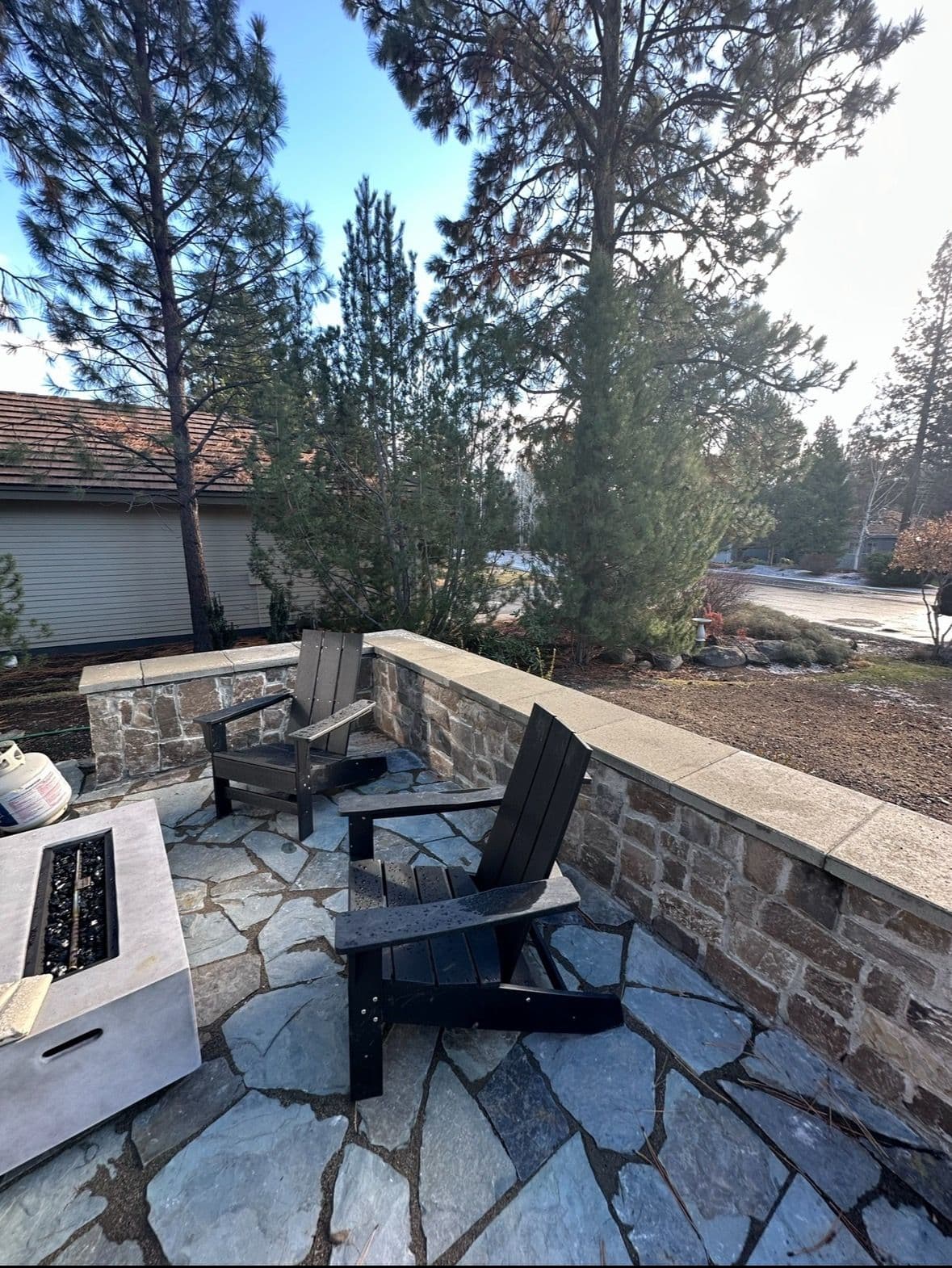
Seat walls get built into the patio instead of added later, so the base goes in once and the wall sits on it. The core is mortared, drainage goes in behind it, and the cap is flat and wide enough to sit on without catching your leg on a lip. Caps are laid with a slight fall so water runs off the face instead of standing in the joint and freezing. A gas fire table gets a level pad set into the field of stone. Fireplaces and heavier stonework are on our masonry page.
The stone itself
The flagstone we lay is quarried regionally: sandstone and quartzite in tans, rusts and grays. Color runs in lots, and two pallets of the same stone can land a shade apart, so we open several at once and blend off them. The field gets laid out dry before anything is bedded, then cut. Stone can carry a lead time, so it gets picked at the proposal stage, not the week we start. A flagstone path or a run of slab steps uses the same stone. We lay it in Bozeman, Belgrade, Four Corners, Gallatin Gateway and Big Sky.
Recent work
Flagstone patio with a capped stone seat wall.
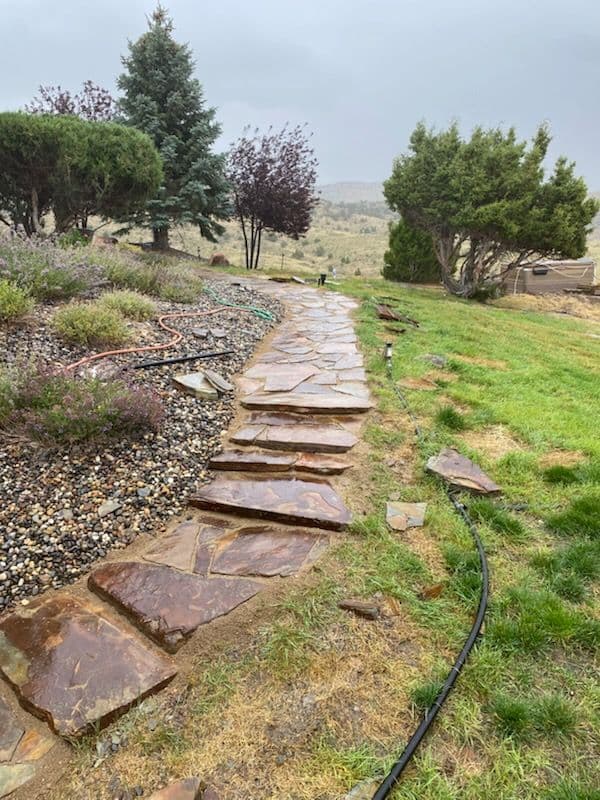
Flagstone path stepping down a grade.
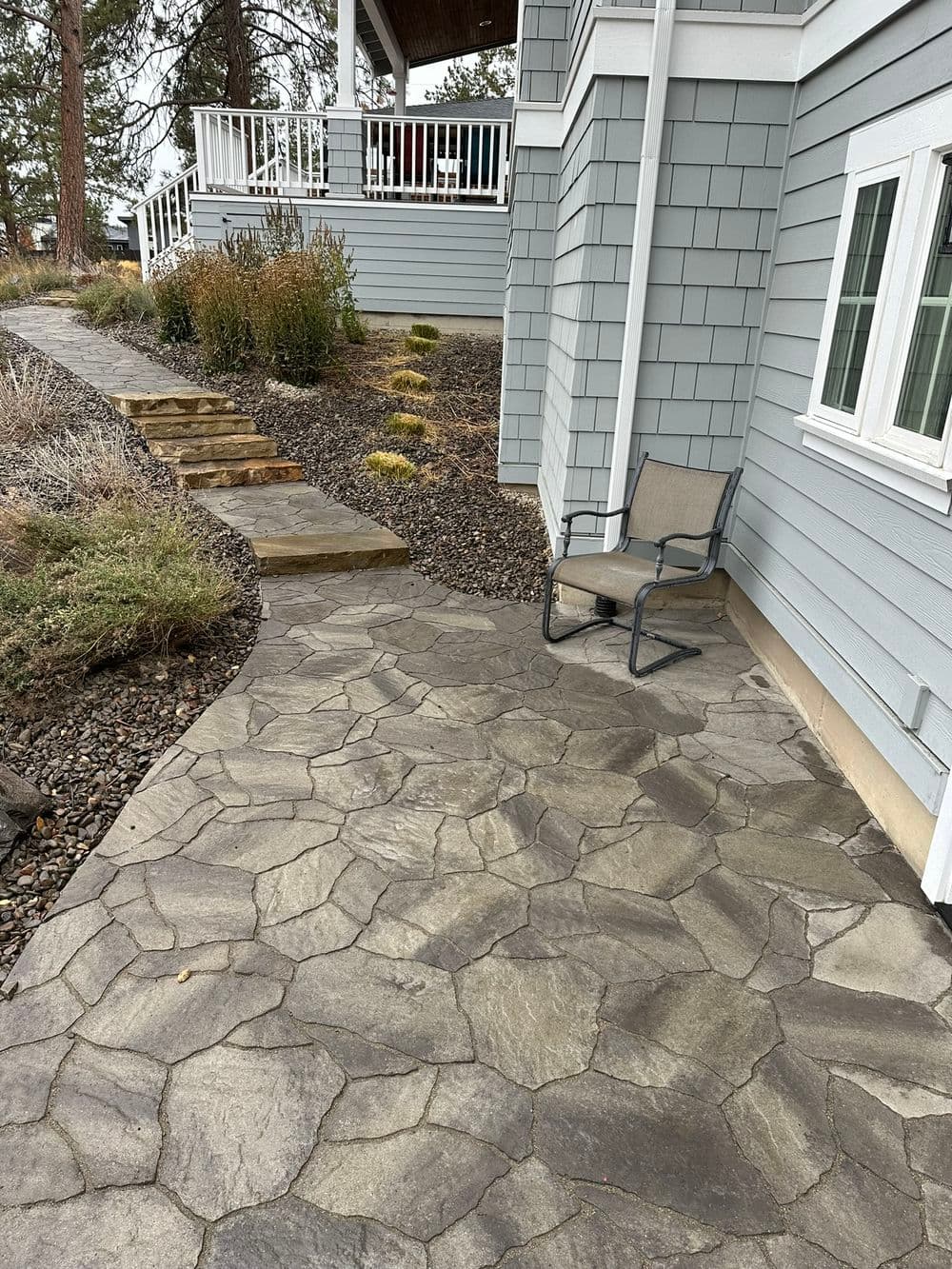
Flagstone-pattern pavers with sandstone slab steps.
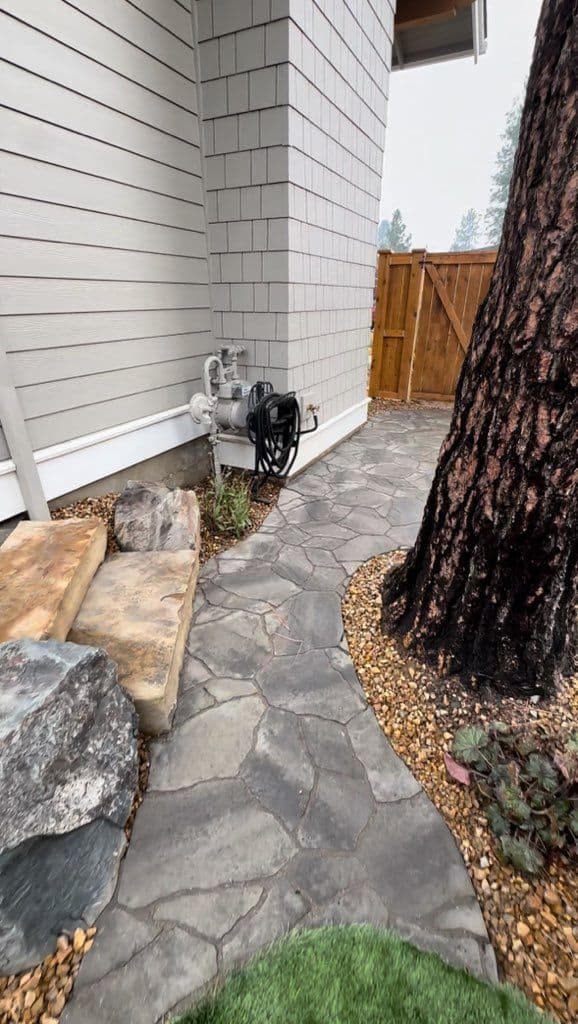
Side yard walkway, gravel shoulders, boulder edge.
Questions we get
- Is flagstone slippery in winter?
- Natural cleft sandstone has a coarse face and it has grip when it is wet. Ice is ice on any hard surface, flagstone included. The bigger winter issue is shoveling: an irregular surface catches a steel blade, so keep a plastic-bladed shovel by that door. Dry-laid joints drain, which keeps standing water off the stone to begin with.
- Can you lay flagstone over my existing concrete patio?
- Often, yes. The slab has to be sound, sitting flat, pitched away from the house, and there has to be height left at the door threshold for a mortar bed and a stone on top of it. If the slab is cracked and the two sides are moving against each other, that crack comes through the new grout inside a couple of winters.
- Do the joints grow weeds?
- Dry-laid joints filled with stone dust or gravel will catch seed, the same as a gravel path, and it pulls out by hand because there is nothing for a root to hold. Mortared joints do not seed. Polymeric sand in flagstone-pattern pavers locks tight enough that little takes. Joints get topped up after the first season either way.
- When can you build a flagstone patio?
- Spring thaw into late fall. Frozen ground cannot be compacted, so base work and dry-laid stone stop once the ground goes hard. Mortar work can keep going into cold weather under tarps with heat. A call in January gets scheduled for the next season, early in the line instead of late.
- How do I get a price?
- Send the form with the address and what you are thinking about, or call or text (406) 577-6201. We come out, measure, look at access and drainage, and you get a written proposal with the scope in it: the stone, the base depth, what is included and what is not.
Related work
- Paver patios built to survive the freeze-thaw
Paver patio installation in Bozeman MT on deep compacted base with poured concrete edge restraint. Send the form for a site visit and a written proposal.
- Masonry and natural stone
Natural stone veneer, outdoor fireplaces, seat walls, flagstone patios and slab steps in Bozeman, MT. Send the form to set up a site visit.
- Paver walkways, stone steps and gravel paths
Paver walkways, front walks, stone steps and gravel paths in Bozeman, MT. Send the form for a site visit and a written proposal with the full scope in it.
Get it priced
Send the form for a site visit, or call or text (406) 577-6201.