
Bozeman, MT · September 25, 2026
Why paver patio edges fail in Montana (and what we use instead)
Spiked plastic paver edging creeps once freeze-thaw lifts the spikes, and the outside course of the patio spreads with it. We pour a concrete curb against the outside course instead, below finished grade where it is never seen.
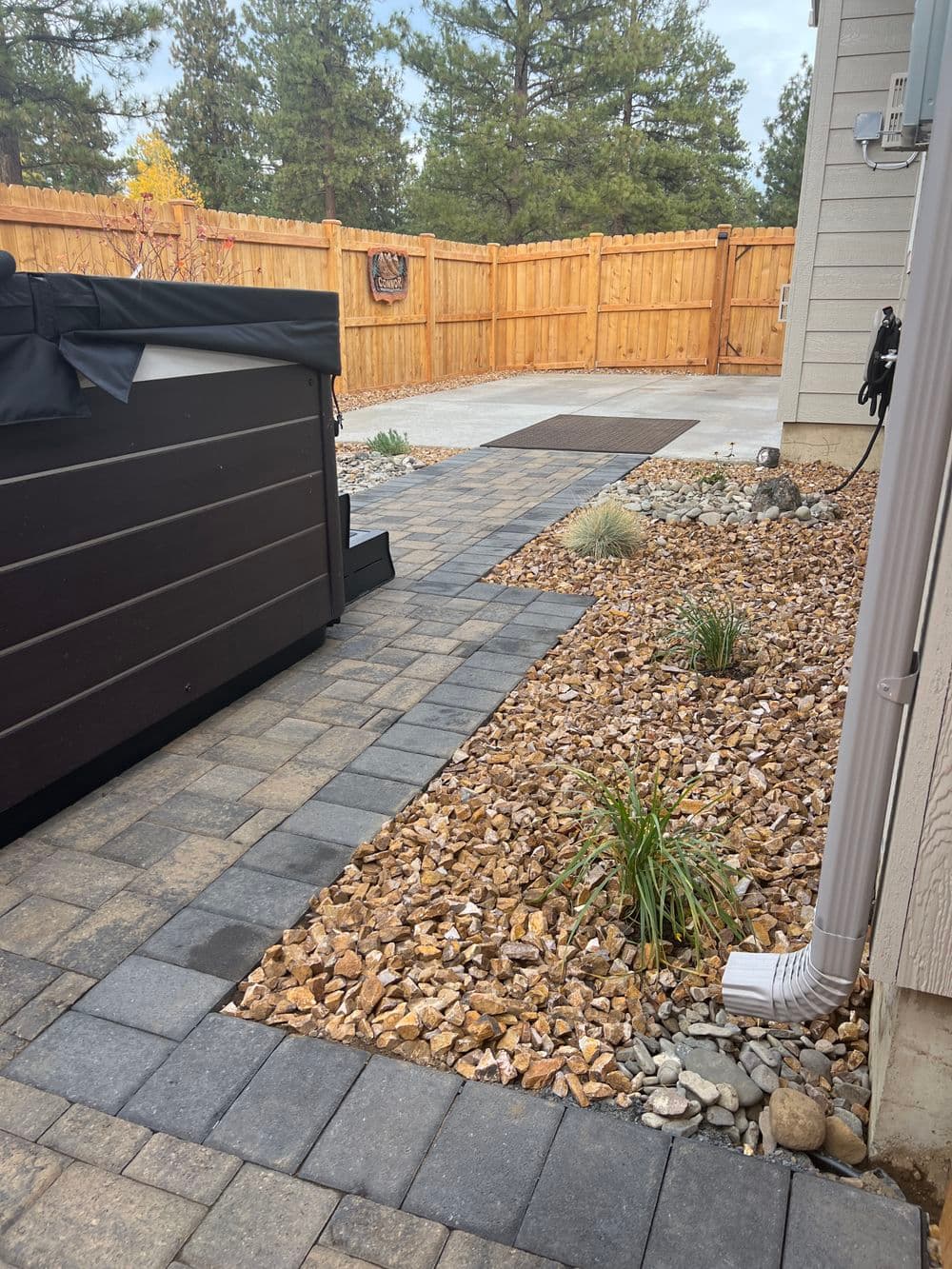
Walkway with a contrasting border course and a rock drainage bed.
Paver edging is the part of a patio nobody looks at until the outside course starts to move. Nothing in the middle of the field can shift unless the perimeter lets go first, so the edge decides whether the patio still reads as a straight line years later. Here is what fails in Montana and what we build instead.
What edge restraint does
Pavers work by interlock. Each unit is held by the units around it and by the sand in the joints, and the field holds together only while the perimeter is confined. Take the restraint away and the outside course leans out a little every time the patio is loaded, walked on, frozen and thawed. The joint behind it opens, sand washes out, and the next course in does the same thing. Restraint is what keeps the field from unzipping from the outside in.
How plastic paver edging is installed, and why it creeps
Spiked plastic edging is the standard cheap answer, and it goes in fast. The install is four steps.
- The base is built a few inches wider than the paver field, so there is compacted rock past the edge to spike into.
- An L shaped plastic rail is set on that shoulder, tight against the outside course of pavers.
- Steel spikes are driven through holes in the flange, down into the base rock.
- Soil or sod is backfilled over the flange so the rail does not show.
It holds for a season. The problem is the spike. A spike is a smooth steel pin sitting in graded rock a few inches below grade, in ground that freezes and thaws all winter at 4,800 feet. Water in the base expands as it freezes and lifts everything above it, the spike included. On the thaw the rock settles back, fine material drops into the void under the spike head, and the spike does not seat all the way down again. A couple of Bozeman winters of that and the spikes walk up out of the base.
Once the spikes are loose, the rail is a strip of plastic lying next to the patio, and the pavers push it outward instead of the other way around. Steel edging is the same idea with a different rail and the same spikes. We do not install either one.
What the failure looks like in year two or three
Nobody calls about edging. They call about the patio.
- The outside course has rolled out and no longer lines up with the rest of the field.
- A joint has opened behind the outside course, wide enough to get a finger into.
- The polymeric sand is gone out of the open joints, and weeds or ants are in there.
- The border has dropped below the field, leaving a sunken lip around the outside.
It starts at the edges that carry load. The step out of a door, the run a wheelbarrow crosses, the edge against a driveway. On a plastic-edged patio the damage is at the perimeter while the middle of the field is still flat, and that pattern is the tell. Pavers spreading at the edge, or a border sinking, is an edge problem. Dips out in the field are a base problem, which is a different repair.
Concrete edge restraint: the haunch we pour instead
Every paver edge we build gets a poured concrete curb. Concrete is formed as a haunch against the outside course, below finished grade, and soil or sod goes back over it, so it is never seen. The haunch sits on the same base as the patio: 3/4" clean crushed base, 8" to 16" deep depending on the soil and the application, compacted in lifts. There is nothing to spike and nothing to jack up out of the rock.
It also confines the edge of the base. Loose crushed rock at the perimeter sloughs sideways once the pavers press on it, and soil backfilled over a plastic flange does nothing to stop that. The curb is one continuous piece around the perimeter and caps the outside face of the base. The rest of the build is on the paver patios page.
Where the patio meets gravel
Where a paver edge runs into gravel, a crushed rock bed or a decomposed granite path, we set a soldier course on top of the concrete curb, a row of pavers turned on end along the perimeter. It gives a hard line between the two materials, so gravel does not migrate into the paver joints. The same detail is on our hardscape page.
What it costs, in plain terms
Concrete edging costs more than plastic on day one. It is more material, forming along the entire perimeter, and the labor to do that forming and pour. There is no number on this page, because perimeter length, how concrete gets to the back of a house, and what the edge runs into all change it. The cost lands once with a curb, at the start, in the proposal. With plastic it lands again in year two or three, as a repair with a crew and a machine on site.
Repairs when a plastic-edged patio has spread
Most of these get fixed without tearing out the patio.
- We pull the plastic rail and the spikes, and cut the sod back far enough to work on the outside face of the base.
- We lift the border course, plus however many courses behind it have moved, and stack them aside.
- We rebuild and re-compact the base where it has sloughed out, then form and pour the concrete curb.
- The border goes back down against the field, the joints get re-sanded, and the surface gets plate compacted with a protective pad.
The whole field has to come up when the problem is under the patio rather than at its edge. If the field has dips, if the bedding sand was run thick to cover a bad base instead of screeded at about an inch, or if the base is shallow or was never compacted in lifts, resetting the border buys a season and no more. We say that at the site visit. A rebuild runs the same sequence as new work: pavers off, subgrade corrected, then 3/4" clean crushed base, 8" to 16" deep depending on the soil and the application, compacted in lifts, and the same pavers back down. It is the base and the edge that failed, not the units.
What to do next
Send the form with the address and what you are thinking about, or call or text (406) 577-6201. We come out, measure, look at access and drainage, and you get a written proposal with the scope in it.
Questions we get
- Does plastic paver edging ever hold up?
- It holds longer in a climate where the base does not freeze and thaw all winter. Bozeman is not that climate, and the edges people use are the loaded ones. We do not install plastic or steel edging, because both are held by spikes driven into base rock that moves.
- Can a concrete edge be added to a patio that is already built?
- Yes, as long as the base under the field is sound. We pull the old edging, lift the border course and whatever behind it has shifted, rebuild the base at the perimeter, pour the curb, then reset the border and re-sand the joints. If the field itself has dips, the base is the problem, and we say so before starting.
- Will the concrete curb be visible around my patio?
- No. The haunch is poured against the outside course below finished grade, and soil or sod covers it. Where the patio meets gravel we set a soldier course on top of the curb, so what shows there is a row of pavers on edge.
- Only one corner of my patio is spreading. Is the rest of it bad?
- Usually not. Corners and loaded edges go first because that is where the push is, and the rest of the perimeter can be a year behind. What matters is whether the field between the edges is still flat, so lay a straightedge across it. A flat field with a moving border is an edge repair. A wavy field is a base repair.
Written by the Liendo Landscaping crew, Bozeman, MT. Call or text (406) 577-6201.