
Bozeman, MT · September 25, 2026
How much does a paver patio cost in Bozeman?
A paver patio in Bozeman is priced by the ground under it, not just the square footage. Here is the installed range per square foot and what moves a job to either end of it.
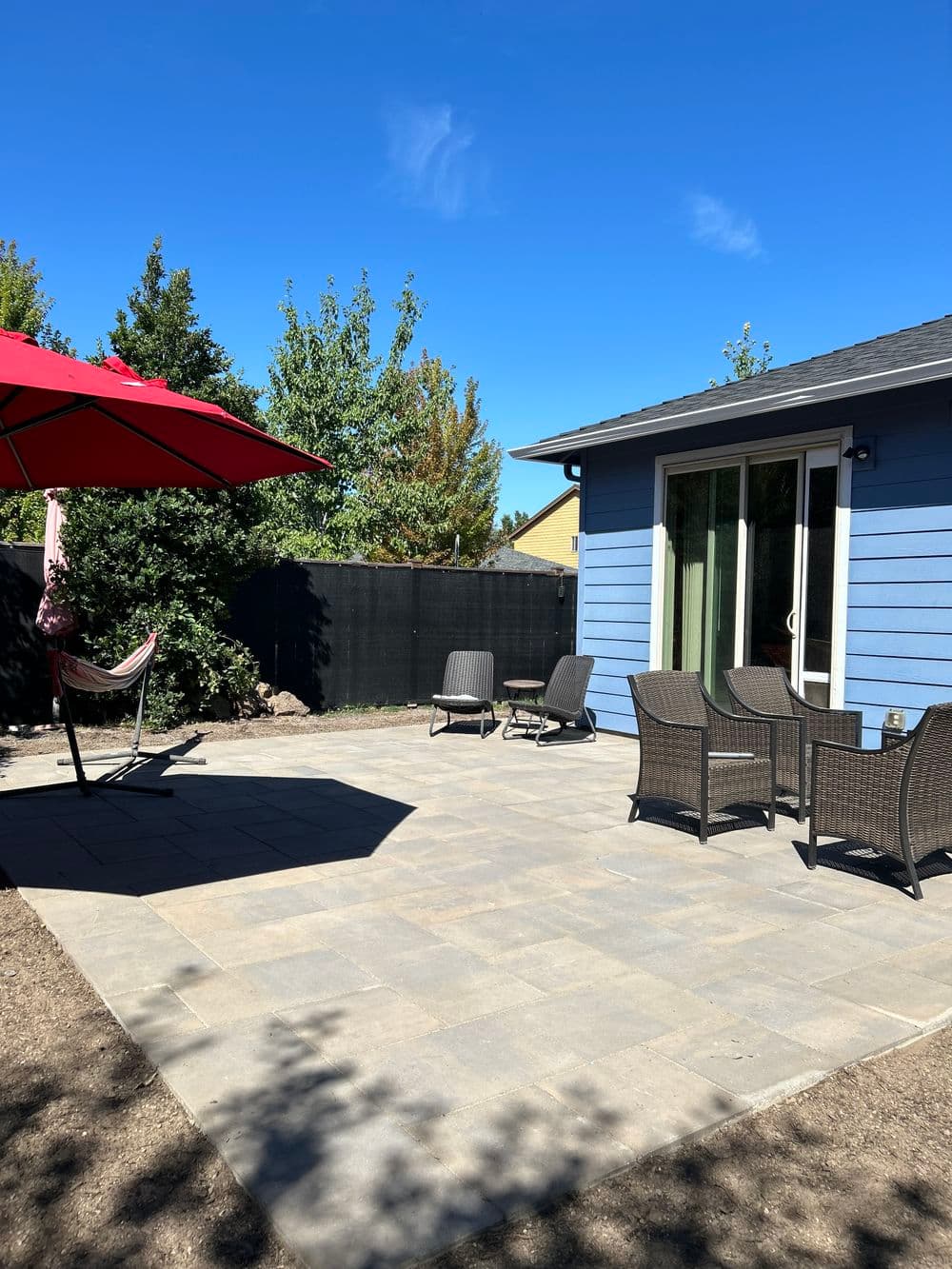
Large-format pavers, cut tight to the house.
Paver patio cost in Bozeman comes down to three things: how much ground has to move, how deep the base has to go, and how much cutting the pattern needs. Here is the range and what pushes a job to either end of it.
What a paver patio costs per square foot in Bozeman
A paver patio in Bozeman runs roughly $34 to $60-plus per square foot installed, depending on the finishes, built on 3/4" clean crushed base, 8" to 16" deep depending on the soil and the application, compacted in lifts. That is a range, not a quote. A simple rectangle in a standard paver, on gravelly ground, with a gate a machine can get through, sits at the low end. Large-format or natural stone finishes, a small patio on clay behind a fence, curves and a step in it, push it to the high end or past it. Nobody can tell you where your yard lands without standing in it.
That range covers the work in the ground and the pavers on top of it: excavation, haul-off, the base, the bedding course, the pavers, the poured concrete edge, polymeric sand and cleanup. A retaining wall, steps, a fire pit, lighting, irrigation moves and sod repair are not in it. Those get priced as their own lines, so you can see each one and leave one out.
What moves the number up or down
Size: small patios cost more per square foot
A 200 square foot patio and a 900 square foot patio need the same machine, the same trailer, the same wet saw and the same day of layout. Spread that across 200 feet and the per-foot number is high. Spread it across 900 and it drops. Small patios are not cheap per foot. They are cheap in total.
Access: wheelbarrow or machine
Access is the biggest single swing on a lot of Bozeman jobs. A gate wide enough for a compact track loader means the rock comes in by machine. An older neighborhood with mature trees and a narrow side yard means every yard of base and every pallet of pavers moves by wheelbarrow, through the gate and around the corner. Same patio, same materials, two or three times the hours in the ground. Alley access, if the lot has it, pulls the number back down.
Soil: how deep the base has to go
Soil here changes block to block. Gravelly ground near the creeks drains and holds compaction, so the base sits at the shallow end. Heavy clay on the valley floor holds water, moves when it freezes, and needs more rock under the pavers, often with geotextile fabric under that. The spec does not change: 3/4" clean crushed base, 8" to 16" deep depending on the soil and the application, compacted in lifts. Where your address falls in that range is a real cost difference, because the deep end is more rock hauled in and more spoils hauled out.
Paver format and pattern
The paver itself is a smaller line than people expect. The pattern is a bigger one. A running bond in a standard rectangular paver cuts fast and wastes little. Herringbone is the strongest layout for a driveway, and it puts a diagonal cut on every perimeter piece, so the edges take hours of wet-saw work. Large-format slabs get set two people to a piece, and a cut across a big slab is slow and unforgiving. Pick the look, then let the proposal show what it costs.
Edge restraint
Every paver edge we build gets a poured concrete curb, a haunch of concrete formed against the outside course and buried below finished grade. It is a real line in the price, and not optional on our jobs. Plastic edging spiked into the base is the cheap alternative, and it is why a lot of patios in this valley have a wandering outside course by year five. The sequence is on paver patios.
Demolition, drainage, steps and walls
An old concrete slab or a rotting deck has to come out and go somewhere first, and broken concrete is heavy and priced by the load. Drainage gets sorted before pavers go down: if the yard holds water into June, or the downspouts dump where the patio is going, that gets piped out or dropped into a river rock bed. Grade changes bring in sandstone slab steps or a retaining wall, which is its own build with its own base, drainage rock and drain line. Any one of these can be a bigger line than the patio.
Permits
A patio usually does not need a building permit. It is flatwork, it holds nothing up, and pitched right it does not change where water leaves the property. A retaining wall is the one that can trigger a permit and an engineered design, and the rules differ between the City of Bozeman and Gallatin County. We tell you which one your address falls under at the site visit.
What a proposal from us lists
Cost questions get answered on paper. What is on the proposal after the site visit:
- Square footage, and the layout it was measured from.
- The paver, the color, the pattern and the border course.
- Base depth stated as a number, not as "to spec".
- Excavation depth, and where the spoils go.
- Edge restraint, drainage work and downspout piping.
- Steps, walls and fire pits as separate lines.
- What is excluded: sod repair, irrigation, lighting, fence work.
- The payment schedule and what a change order looks like.
Changes after that go in writing before anyone builds them. The number on the proposal is the number unless the scope changes or we hit something under the ground nobody could see, and then you approve it before we build past it.
Cheaper is usually a thinner base or plastic edging
When two bids on the same patio are thousands apart, the difference is almost never the pavers. Pavers cost what pavers cost. The difference is under them. Four inches of base instead of eight to sixteen. Road mix with fines in it instead of 3/4" clean crushed rock. A thick sand bed poured in to level a base that was never graded, which is what makes a patio roll and dip. Plastic edging instead of a poured concrete curb.
None of that shows on the day the last paver goes down. It shows the spring after the second winter, when the low corner holds a puddle for two days and the outside course has walked out a half inch. Read a low bid for what it leaves out. If it does not state a base depth, it does not have one.
What to do next
Send the form with the address and what you are thinking about, or call or text (406) 577-6201. We come out, measure, look at access and drainage, and you get a written proposal with the scope in it.
Questions we get
- Is a paver patio cheaper than a concrete slab?
- On the day it is poured, a plain slab is usually less per square foot. Over a Montana freeze-thaw cycle the math shifts. A slab cracks and you live with it or break it out. A settled paver section gets lifted, re-based and re-laid with no seam showing.
- Why is another bid so much less per square foot?
- Usually size, access or base. A bigger patio spreads the setup across more feet. A yard a machine can reach costs less than one where the rock comes in by wheelbarrow. And a four inch base is cheaper than a twelve inch base until the ground freezes. Ask what base depth the other bid states.
- What happens at the site visit?
- Twenty to forty minutes. We measure the area, walk the route a machine or a wheelbarrow would take to reach it, look at the downspouts and where water sits, and check the grade off the house. Then you get a written proposal with the materials, the base depth and the exclusions.
- Can the price change once you start digging?
- The scope on the proposal is what we hold to. What changes it is something under the ground nobody could see: an old slab buried under fill, a spring, a line that is not where the locate marked it. If we hit one, you approve the change in writing before we build past it.
- When can you build?
- Hardscape runs from spring thaw into late fall. Frozen ground cannot be compacted, so excavation and paver work stop in winter. A patio priced in November gets scheduled for the next season, which means you are early in the line rather than behind the spring rush.
Written by the Liendo Landscaping crew, Bozeman, MT. Call or text (406) 577-6201.