
Bozeman, MT · September 25, 2026
Why a paver base in Bozeman is 8 to 16 inches, not 4
Four inches of base is a mild-climate spec. In Bozeman the ground freezes deep, and what moves in that cycle is water held in soil. The base is what keeps it from lifting your pavers.
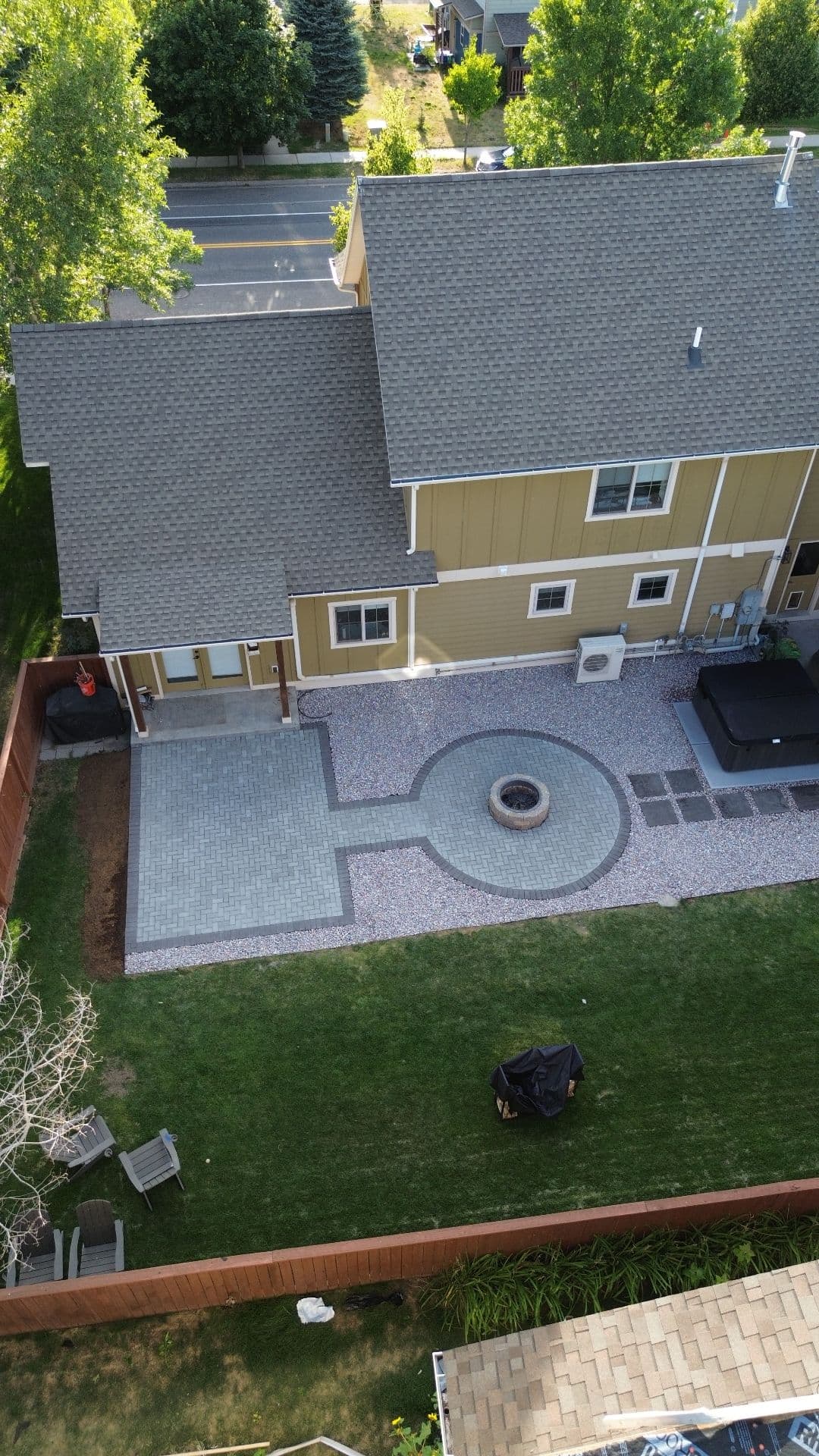
Square patio, circular fire pit court, gravel bands between.
Four inches of base under a paver patio is a fine spec in a mild climate. In Bozeman it is a two year patio. The ground here freezes deep, thaws, and freezes again, and what moves in that cycle is water held in soil. The base keeps it from lifting your pavers.
What frost heave actually is
Water expands about nine percent when it freezes. Sitting in the fine grains of a clay or silt soil it has nowhere to go but up, so the ground lifts. It gets worse: a freezing front in fine soil pulls more water toward itself from below and stacks it into ice lenses, so the lift is bigger than the water that was there to start with. Then it thaws, the ice turns back to water, and the ground drops.
The lifting is not the problem. The unevenness is. The strip along the south wall of the house thaws in February. The corner in the shade of the fence stays frozen into April. One part of the patio goes up while another stays put, and the pavers, being rigid, take that difference across the joints. Run that thirty or forty times a winter, every winter, and a patio built on soil goes out of plane and stays there.
Why clean crushed rock does not heave the way soil does
What we build on is 3/4" clean crushed base, 8" to 16" deep depending on the soil and the application, compacted in lifts. The load-bearing word is clean. Clean crushed rock is washed with the fines screened out, so the voids between stones stay open. Water runs through and keeps going down instead of sitting in it. No held water, no ice lenses, almost nothing to expand. Crushed stone also locks together when compacted, because the fractured faces key against each other, which is why it is crushed rock and not pea gravel. Road mix and pit run keep their fines on purpose, because fines are what make them pack hard for a road. Those same fines hold water, and held water is the whole problem here.
Why the depth is a range and not one number
Eight inches and sixteen inches are both right, on different lots. What decides it:
- Gravelly, free-draining ground near the creeks: the shallow end. The native soil is doing half the job.
- Heavy clay on the valley floor: the deep end. Clay holds water and moves when it freezes.
- What goes on top: a walking patio sits shallow, a driveway apron or anything a truck parks on sits deep.
- How wet the site is: ground that stays soft into June gets more depth and geotextile under the rock.
- What is under the topsoil: builder fill and buried debris come out first, and that hole gets built back in base rock.
It is also why a per-square-foot number means little without an address attached. Sixteen inches of base is twice the excavation, twice the spoils hauled off and twice the rock hauled in of an eight inch base. The cost side is in how much a paver patio costs in Bozeman.
How the base actually goes in
Compaction in lifts
Rock goes in about four inches at a time and every lift gets compacted before the next one goes on. A plate compactor only reaches so far down. Dump twelve inches in one go, run a plate over the top, and you get a hard crust with loose rock under it, which reads as compacted on the day and settles for five years. The rock gets wetted down when it is dry enough that it will not knit together. It is the slowest part of the job and the most commonly skipped.
Geotextile on soft subgrade
On soft or wet subgrade, geotextile fabric goes down between the native soil and the base rock. Without it the base pumps down into the mud under load while the mud works up into the base, and you lose the base you paid for. The fabric separates the two so the rock keeps working as rock. It is cheap, and not needed everywhere, which is why it belongs on a proposal as a decision rather than a default.
The bedding course is about an inch, and not more
On top of the compacted base goes a thin screeded bedding course, about an inch, no more. A thick sand bed is the fastest way to waste a good base. Sand is not a structural layer. It migrates under load, washes out at the edges, and lets pavers find their own level independently, which is what makes a patio roll and dip. A two or three inch sand bed is usually there to level a base that was never graded.
Polymeric sand in the joints
Joint sand is what makes a paver field behave as one surface instead of a few thousand loose blocks. Polymeric sand is swept in dry, the surface is compacted with a plate and a protective pad, and the sand is then activated with water and sets up firm. It is not a sealant and not permanent. Joints give up a little sand the first year, which is why we re-sand what settles.
Concrete edge restraint, not plastic
All of the above comes undone if the perimeter is not held. Plastic edging is a strip spiked into the base, and freeze-thaw is very good at lifting spikes. The edging rises, loosens, and the outside courses spread. Every paver edge we build gets a poured concrete curb formed against the outside course and buried below finished grade. We do not use plastic and we do not use steel.
What a heaved patio looks like after the second winter
The first spring it looks fine. The second spring is when you see it. One corner sits about a half inch proud of the pavers next to it, enough to catch a chair leg and enough to feel through a shoe. A low spot holds a puddle for two days after rain while the rest of the patio is dry. The joint sand along the outside course is gone and a thin green line of growth has come up in the gap. In one place the plastic edging shows above grade where a spike pulled. Nothing has failed. It just does not sit flat any more, and it is not going back on its own.
What to do next
Send the form with the address and what you are thinking about, or call or text (406) 577-6201. We come out, measure, look at access and drainage, and you get a written proposal with the scope in it.
Questions we get
- Can I just lay pavers on sand?
- On a garden path nobody minds re-leveling, sure. On a patio in Bozeman, no. Sand is a bedding layer, not a base. It holds water, it moves when that water freezes, and it migrates sideways under load. With no compacted crushed rock under it, nothing keeps the surface in plane.
- Is four inches of base ever enough here?
- Four inches is a mild-climate spec, and plenty of patios in warmer places sit on it and stay flat. Here the frost depth for footings is 36 inches, which tells you how deep this ground freezes. Four inches of rock is not enough between a paver and a clay soil that is going to move.
- Does a walkway need as much base as a patio?
- A walkway carries less load than a patio and far less than a driveway, so it sits toward the shallow end. The soil still gets a vote. A walk across heavy clay in a shaded side yard can need more base than a patio on gravel in full sun.
- What is the difference between 3/4" clean and road mix?
- Clean crushed rock is washed and the fines are screened out, so it drains. Road mix keeps its fines on purpose so it packs into a tight hard layer, which is what a road wants and a paver base does not. Fines hold water. Held water freezes.
- Can a patio that has already heaved be fixed?
- Usually, and usually without redoing all of it. The affected section comes up, the base under it gets corrected and re-compacted, and the same pavers go back down, which is one of the real advantages of pavers over a slab. If the base is four inches of the wrong rock across the whole patio, spot repairs will keep coming back.
Written by the Liendo Landscaping crew, Bozeman, MT. Call or text (406) 577-6201.